Here is a Barber Dime in very, very nice condition found in New Jersey (undisclosed location)

Showing posts with label Treasure hunting. Show all posts
Showing posts with label Treasure hunting. Show all posts
May 14, 2019


Mar 12, 2013
How To Fly Your Garrett AT Pro Metal Detector

Jan 9, 2012
Lost Treasure Under The St Augustine Sand


Bob Spratley has a lot of secrets.
He knows where to find 20 shipwrecks around St. Augustine, he can find gold and silver buried beneath the sands of local beaches, and he discovered one of the sites of the nation’s most notorious slaughters.
“He found the Matanzas site, the massacre site,” said John Powell, living history interpreter at the Fountain of Youth. “Bob is beyond a metal detectorist. Bob is touched by God.”
Spratley has been hunting with a metal detector for 41 years. Research, skill and maybe a little luck have led him to shipwrecks, Spanish outposts and historical sites that archaeologists wish they knew about.
His collection contains thousands of relics, and the walls of his home read like a museum: 16th century Spanish and French gold coins and weapons, buttons and buckles, crosses and amulets, cannons and guns.
“It gets in your blood, and once it gets in your blood, you’re a victim,” he said, a Spanish silver piece of eight worth $35,000 hanging from his neck. “If you want a collection like this, you dig everything.”
Spratley protects his collection with coded log books of his finds and shares information only with trusted sources. He doesn’t tell archaeologists where he finds things because, as he says, he doesn’t want the sites to be roped off, he doesn’t want the history he uncovers to be put on a shelf. Archaeologists and treasure hunters don’t work well together, he says, because archaeologists see treasure hunters as a danger to historical preservation.
For Spratley, finding treasure is not the only goal. Hunting down the secrets of history is a passion that runs parallel to metal detecting.
His hobby has led him all over the country to go detecting and into his home office for countless hours of research and study.
About 20 years ago, Spratley began researching the Matanzas site where, in 1565, Pedro Menéndez de Aviles slaughtered hundreds of Frenchmen under Jean Ribault somewhere near the site of where Fort Matanzas stands today.
The hundreds of French who died on those beaches left behind coins, buckles, and weapons. They left their stories in the sand.
Hundreds of years later, metal detector in hand, Spratley began to uncover what he believes is the site of the slaughter. It took about 15 years for him to find the site, he said.
History books say that Ribault’s men were slaughtered near the Matanzas inlet, that’s why the name means place of slaughters. Spratley says he thinks he has found the exact location of the massacre.
“That’s why I say it took place here. You find weapons,” he said as he held a Spanish crossbow bolt from the 1500s on a local beach, what he says is the massacre site, just after dawn.
Spratley made clear that the location of this dig, like the other sites, is to be kept a secret.
A nor’easter had blown through and sifted treasures closer to the surface a couple of weeks before the hunt. After a quick briefing from Spratley, a select group of his friends and acquaintances scoured the coastline, speckling a stretch of sand with scoop holes. Within 30 minutes, treasure surfaced.
Touching history
Butch Holcombe is the editor and publisher of American Digger magazine, a magazine for relic hunters and metal detecting enthusiasts. He came from Georgia for the hunt, and he got lucky.
“Holding hands with history,” Holcombe exclaimed as he held a freshly unearthed, possibly 16th century Spanish buckle in his hands. Holcombe is used to hunting in Georgia for Civil War relics, he said. Finding anything from the 19th century is exciting. But this, this is from the 1500s.
“I love holding something that old,” he said, staring at the buckle in his palm. “Touch of Spain, wow.”
Quickly, the hunt continued. Headphones went back on, legs lurched forward and detectors swayed from side to side. There were more discoveries, and, as with most hunts, there were some duds mixed in with the sand.
“Bob, what’s this?” Jerry Solomon from Dallas, Ga., asked as he held up a sand-coated object.
“It’s a penny,” Spratley said after a glance.
‘Amazing’ finds
Spratley acts as historical interpreter for most of the finds on the beach, but he sometimes seeks out help from other sources, archaeologists, professors, and antiquity experts. One source is John Powell, living history interpreter at the Fountain of Youth. He is a archaeological conservationist and military weapons expert of the Spanish period.
Powell spent some time flipping through pictures of Spratley’s finds in a parking lot near St. George Street. He identified the relics in the pictures almost immediately.
“I’ve avoided digging for myself,” Powell said, dressed in colonial Spanish garb as he leaned on the trunk of a car one afternoon.
Powell has worked in antiquity since he was 8 years old, he said. He metal detects, but uses his expertise to help Carl Halbirt on some digs. He avoids treasure hunting to preserve his relationship with the archaeological community, but also helps Spratley.
“I know Bob very well. I help him to identify what he finds,” he said. “He comes up with things that are absolutely amazing.”
In addition to the Matanzas site, Spratley has found Spanish campsites, he said.
Powell’s interest in the finds are reproduction — having molds made from historical finds like jewelry that can be recreated and worn by himself and other historical re-enactors.
Later on during the hunt at the Matanzas site, Spratley shouted. He had made the find of the day.
He nudged back a layer of sand to reveal a bronze Caravaca cross, probably 16th or 17th century.
Typically carried by monks or priests for religious purposes, the cross was named after the southeastern Spanish town of Caravaca de la Cruz and has been associated with miracles, he said. People other than monks or priests used the Caravaca cross for good luck and protection. Finds like the cross are what add an element of controversy to treasure hunting. This isn’t someone’s lost Rolex. This is a historical relic.
Not stealing history
“People frown upon us because they think we’re stealing history,” Spratley said. “We’re not. We’re displaying, showing people.”
Spratley said he loves to share the treasures he unearths, but on his own terms. In particular, he likes to share history with children. He has been to local schools, including Middleburg High School, where he displayed a conquistador helmet, signal cannon, olive jars and other relics.
The goal is to let kids hold history and get inspired by it, he said. “I let the kids hold it, even though it’s priceless,” he said about the relics. “That’s the future of history is the kids that are in school today...If just one goes on to study history, it tickles me to death.”
Spratley doesn’t sell anything of historical value, he said. He sells lost rings, watches and other jewelry to support his hobby, which he took up full time after retiring as a real estate broker in 2004.
Spratley has collected a trove of secrets after 41 years of metal detecting, and a storeroom full of treasure that he worries about how to preserve now and after he’s gone. After coming back from Vietnam, detecting was a way to get back into society and deal with anxiety. Treasure hunting has been a hobby, a passion and a pain reliever throughout the past four decades.
After Spratley found the Caravaca cross on the beach that day, he put his detector down for awhile. He wanted to give the others a chance to dig up something big. It’s not all about the treasure, he said. For Spratley, the relic hunter, the most valuable thing he’s found is intangible.
“Freedom,” he said, “to be able to do what I want and share it with people.”
Tools of the trade – the basics
■ Metal detector-waterproof (a good one): $1,000 & up
■ A long handle sand scoop: $110 to $150
He knows where to find 20 shipwrecks around St. Augustine, he can find gold and silver buried beneath the sands of local beaches, and he discovered one of the sites of the nation’s most notorious slaughters.
“He found the Matanzas site, the massacre site,” said John Powell, living history interpreter at the Fountain of Youth. “Bob is beyond a metal detectorist. Bob is touched by God.”
Spratley has been hunting with a metal detector for 41 years. Research, skill and maybe a little luck have led him to shipwrecks, Spanish outposts and historical sites that archaeologists wish they knew about.
His collection contains thousands of relics, and the walls of his home read like a museum: 16th century Spanish and French gold coins and weapons, buttons and buckles, crosses and amulets, cannons and guns.
“It gets in your blood, and once it gets in your blood, you’re a victim,” he said, a Spanish silver piece of eight worth $35,000 hanging from his neck. “If you want a collection like this, you dig everything.”
Spratley protects his collection with coded log books of his finds and shares information only with trusted sources. He doesn’t tell archaeologists where he finds things because, as he says, he doesn’t want the sites to be roped off, he doesn’t want the history he uncovers to be put on a shelf. Archaeologists and treasure hunters don’t work well together, he says, because archaeologists see treasure hunters as a danger to historical preservation.
For Spratley, finding treasure is not the only goal. Hunting down the secrets of history is a passion that runs parallel to metal detecting.
His hobby has led him all over the country to go detecting and into his home office for countless hours of research and study.
About 20 years ago, Spratley began researching the Matanzas site where, in 1565, Pedro Menéndez de Aviles slaughtered hundreds of Frenchmen under Jean Ribault somewhere near the site of where Fort Matanzas stands today.
The hundreds of French who died on those beaches left behind coins, buckles, and weapons. They left their stories in the sand.
Hundreds of years later, metal detector in hand, Spratley began to uncover what he believes is the site of the slaughter. It took about 15 years for him to find the site, he said.
History books say that Ribault’s men were slaughtered near the Matanzas inlet, that’s why the name means place of slaughters. Spratley says he thinks he has found the exact location of the massacre.
“That’s why I say it took place here. You find weapons,” he said as he held a Spanish crossbow bolt from the 1500s on a local beach, what he says is the massacre site, just after dawn.
Spratley made clear that the location of this dig, like the other sites, is to be kept a secret.
A nor’easter had blown through and sifted treasures closer to the surface a couple of weeks before the hunt. After a quick briefing from Spratley, a select group of his friends and acquaintances scoured the coastline, speckling a stretch of sand with scoop holes. Within 30 minutes, treasure surfaced.
Touching history
Butch Holcombe is the editor and publisher of American Digger magazine, a magazine for relic hunters and metal detecting enthusiasts. He came from Georgia for the hunt, and he got lucky.
“Holding hands with history,” Holcombe exclaimed as he held a freshly unearthed, possibly 16th century Spanish buckle in his hands. Holcombe is used to hunting in Georgia for Civil War relics, he said. Finding anything from the 19th century is exciting. But this, this is from the 1500s.
“I love holding something that old,” he said, staring at the buckle in his palm. “Touch of Spain, wow.”
Quickly, the hunt continued. Headphones went back on, legs lurched forward and detectors swayed from side to side. There were more discoveries, and, as with most hunts, there were some duds mixed in with the sand.
“Bob, what’s this?” Jerry Solomon from Dallas, Ga., asked as he held up a sand-coated object.
“It’s a penny,” Spratley said after a glance.
‘Amazing’ finds
Spratley acts as historical interpreter for most of the finds on the beach, but he sometimes seeks out help from other sources, archaeologists, professors, and antiquity experts. One source is John Powell, living history interpreter at the Fountain of Youth. He is a archaeological conservationist and military weapons expert of the Spanish period.
Powell spent some time flipping through pictures of Spratley’s finds in a parking lot near St. George Street. He identified the relics in the pictures almost immediately.
“I’ve avoided digging for myself,” Powell said, dressed in colonial Spanish garb as he leaned on the trunk of a car one afternoon.
Powell has worked in antiquity since he was 8 years old, he said. He metal detects, but uses his expertise to help Carl Halbirt on some digs. He avoids treasure hunting to preserve his relationship with the archaeological community, but also helps Spratley.
“I know Bob very well. I help him to identify what he finds,” he said. “He comes up with things that are absolutely amazing.”
In addition to the Matanzas site, Spratley has found Spanish campsites, he said.
Powell’s interest in the finds are reproduction — having molds made from historical finds like jewelry that can be recreated and worn by himself and other historical re-enactors.
Later on during the hunt at the Matanzas site, Spratley shouted. He had made the find of the day.
He nudged back a layer of sand to reveal a bronze Caravaca cross, probably 16th or 17th century.
Typically carried by monks or priests for religious purposes, the cross was named after the southeastern Spanish town of Caravaca de la Cruz and has been associated with miracles, he said. People other than monks or priests used the Caravaca cross for good luck and protection. Finds like the cross are what add an element of controversy to treasure hunting. This isn’t someone’s lost Rolex. This is a historical relic.
Not stealing history
“People frown upon us because they think we’re stealing history,” Spratley said. “We’re not. We’re displaying, showing people.”
Spratley said he loves to share the treasures he unearths, but on his own terms. In particular, he likes to share history with children. He has been to local schools, including Middleburg High School, where he displayed a conquistador helmet, signal cannon, olive jars and other relics.
The goal is to let kids hold history and get inspired by it, he said. “I let the kids hold it, even though it’s priceless,” he said about the relics. “That’s the future of history is the kids that are in school today...If just one goes on to study history, it tickles me to death.”
Spratley doesn’t sell anything of historical value, he said. He sells lost rings, watches and other jewelry to support his hobby, which he took up full time after retiring as a real estate broker in 2004.
Spratley has collected a trove of secrets after 41 years of metal detecting, and a storeroom full of treasure that he worries about how to preserve now and after he’s gone. After coming back from Vietnam, detecting was a way to get back into society and deal with anxiety. Treasure hunting has been a hobby, a passion and a pain reliever throughout the past four decades.
After Spratley found the Caravaca cross on the beach that day, he put his detector down for awhile. He wanted to give the others a chance to dig up something big. It’s not all about the treasure, he said. For Spratley, the relic hunter, the most valuable thing he’s found is intangible.
“Freedom,” he said, “to be able to do what I want and share it with people.”
Tools of the trade – the basics
■ Metal detector-waterproof (a good one): $1,000 & up
■ A long handle sand scoop: $110 to $150
Jan 5, 2012
Metal Detecting On The South West Florida Coast
Dec 22, 2011
Garrett AT-Pro Metal Detector Strikes Silver
I've included a link below from Amazon which is about the best deal you kind find on a Garrett AT Pro that I have seen anywhere. If you know of a better deal on a brand spanking new metal detector, please feel free to post it in the comments section. The package below is hard to beat!
Garrett At Pro Metal Detector - Professional Treasure Hunter's Detector W/8.5" X 11" Coil, Free
Headphones 4 Free Bonus Items

Nov 11, 2011
$4 Million In Stolen Idaho Gold-Big Dave's Buried Treasure
The Port Neuf Canyon Stage Robbery & Murder
Aug 31, 2010
New York Treasure Hunting Deluxe - The Oriskany Patent
A map of the vast Oriskany Patent, drawn in 1789, provides a very detailed look at the extreme Upper Mohawk Valley at the close of the Revolutionary War. This is also an excellent resource for the sharp eyed detectorist ...
 At the west end of the patent (top of the map) one can see the portage between the Mohawk River and Wood Creek, with the fort guarding this portage (then called "Fort Schuyler" and later "Fort Stanwix") being passed closely by the river road.
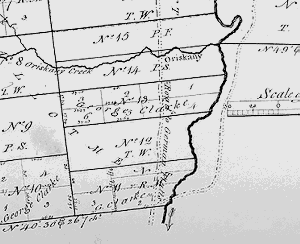 At the eastern end of the patent (bottom of the map), the relationship of the patent boundary to Oriskany Creek can be seen (see detail above). At this spot the river road branches with one segment crossing the river to the north. A modern highway follows this same alignment today. These maps are never going to have the proverbial "X marks the spot" but for those of you that already know the area or have done some research, they can be a wealth of information.
Both myself and Treasure Dave are big believers in canoes for treasure hunting. Most of the old water routes are the best and ONLY way to access a ton of virgin spots, a canoe can help you cover a good bit of stream and this is also the reason I recommend owning "amphibious" metal detectors. I know that the Fisher CZ-21 or the MineLab Excalibur's are expensive but you really need a waterproof machine if you want to do any serious hunting and they are worth the extra cash, it's not uncommon for Dave and I to be in three feet of water one minute and high up on a creek bank the next. We could never use a land machine to do this kind of hunting.
Here is another map of the patent of Oriskany for closer examination .... Just Click Here!
Good Hunting!


Both myself and Treasure Dave are big believers in canoes for treasure hunting. Most of the old water routes are the best and ONLY way to access a ton of virgin spots, a canoe can help you cover a good bit of stream and this is also the reason I recommend owning "amphibious" metal detectors. I know that the Fisher CZ-21 or the MineLab Excalibur's are expensive but you really need a waterproof machine if you want to do any serious hunting and they are worth the extra cash, it's not uncommon for Dave and I to be in three feet of water one minute and high up on a creek bank the next. We could never use a land machine to do this kind of hunting.
Here is another map of the patent of Oriskany for closer examination .... Just Click Here!
Good Hunting!
Aug 30, 2010
True Treasure Tales From Colonial Upstate NY
The Story of the Money Hole

An Address Delivered Before a Joint Meeting of the Mohawk Valley Historical Association and the Van Epps-Hartley Chapter, New York State Archeological Assn., 1936. (By Robert M. Hartley.)
Many brave men never came back from the field of Oriskany on that memorable August day in 1777. Some of the most prominent residents of Old Warrensburg died there and their bodies were never recovered or buried. Among them was Samuel Pettingill, a well to do farmer and country doctor, he was a man of education and influence and a captain in Col. Frederick Fisher's Third Tryon County Militia.
Family tradition is that on the morning of the day he marched with his company to join General Herkimer for the relief of Fort Stanwix, that having a considerable savings of silver money, which evidently he feared to leave during his supposed temporary absence he put this money in an old copper teapot of tea kettle, picked up a shovel and walked eastward from his house to the woods near the Chuctamunda creek where he buried his savings. His family had noted with interest all his preparations, but none accompanied him, merely noting the direction he had taken towards the creek, consequently were in ignorance of the exact spot he had chosen as a safe hiding place from theft and possible raiders. It is said he was gone a short half hour. That afternoon he marched away, and never returned. Many searches were made by the family for this buried money, but without results. Though the years that followed its burial, many friends and neighbors assisted in the search, but its hiding place was never discovered.
About thirty-five years ago two of Capt. Samuel Pettingill's great great grandsons, Dewitt and Milton Devendorf, enthusiastically renewed the search in which I and others assisted. During the early springtime we prodded over several acres with sharp pointed steel rods and many excavations were made where the rods indicated obstructions that did not feel like stones. However, the labor expended was no more successful than all previous searches. Captain Pettingill's hiding place of where he buried his money on that August morning, so long ago, perhaps will never be known.
The tradition of this buried treasure still lingers, for the ravine near where the money was supposed to be buried has been commonly known for a hundred years or more as "The Money Hole."

As the next two stories have to do with the Ross and Butler raid on Warrensbush in October, 1781, it may not be amiss to here explain why this last raid was made.
(These are also excellent sites to metal detect, pay attention to landmark clues!)
Warrensbush was the most eastern section of Tryon County and because of its close proximity to Schenectady and Albany and their protection, few raiders had previously been able to penetrate and successfully destroy this settlement and Duanesburgh, while the people of all other sections along the frontier to the south and west were badly torn and quite destitute. Consequently, Warrensbush, until october, 1781, was as yet almost untouched and able to supply its less fortunate neighbors with much of their wheat and other necessary supplies. Knowing this, Governor Haldiman in the spring of 1781, sent spies into the Mohawk country to learn the condition of the people of Warrensbush and of their security against attack. These spies reported back that the people were alert to invasion. However, Haldiman was determined to destroy this settlement of possibly by a swift and secret attack. This raid was carefully planned by the Governor and his most experienced Ranger and Indian officers. Every detail was studied for its successful accomplishment, as all previous raids had lost their force before reaching this thickly settled section, which was producing for their more unfortunate neighbors in the Schoharie and upper Mohawk Valley the supplies they so badly needed. So during the summer preparations were made to send a picked forced of about a thousand men and Indians, under the command of Major John Ross and Lieut. Walter Butler, to destroy Warrensbush and Duanesburgh. A complete account of these preparations for this raid is contained in Chapter 10, of Cruickshank's History of the Royal Regiment of New York," ("Johnson's Greens") and also of Major Ross' official report to Gov. Haldiman, of the results of this expedition in which he states: "In seven miles of Warrensbush every house was in flame, 100 farms, three miles and a large granary for public use were reduced to ashes, the cattle and livestock were likewise destroyed--the inhabitants fled in the night, etc., etc."
The raiders advanced rapidly from Oswego over unfrequented trails, but when near Corry's Mush (Root) were discovered and an alarm was sent to the eastern settlements of Tryon and Schenectady counties. But by marching all night the invaders crossed the Schoharie creek near Fort Hunter, where they lay in the woods on the present Billing's farm on Yankee Hill, until daylight, when various detachments were sent out to destroy the settlements before help could reach them from Schenectady and other points. Among the descendants of Florida's pioneer families there still lingers stories and traditions of many thrilling escapes that have never been published. Simms, Beers and Frothingham histories have recorded many family traditions of the raids in the central and upper Mohawk and Schoharie Valley sections, but comparatively little of the escapes and experiences of the settlers of Warrensbush in one of the worst and most destructive raids that ever befell any section of our frontier at any one time has even been published. Perhaps this may be accounted for as it was the last great invasion in the Mohawk country just at the close of the Revolution and that while the results of the raid was quite complete, the effect was not so far reaching and sooner recovered, than had it come earlier in the war, but the war was ended and the inhabitants left to themselves without further fear, immediately began to recover and rebuild. This raid on Warrensbush ended with the battle of Johnstown late that afternoon and the death of Walter Butler on the retreat, at the crossing of the West Canada Creek the following morning.
The Escape of Mrs. Pettingill and Her Family in the Ross and Butler Raid of 1781.
This story had to do with another loss and near tragedy that befell the widow and family of Captain Samuel Pettingill. You will remember that Capt. Pettingill was killed at Oriskany. The death of husband and father must have been an almost paralyzing loss to his wife as she was left with a family of thirteen children, but courageous woman as she was, they had managed to live and we find them in the fall of 1781 living on their farm on the highlands in the southwestern part of the town with sufficient feed for their few cattle and supplies for the family for the coming winter.
One of the detachments sent out from the raider's temporary encampment on Yankee Hill, as previously mentioned, was discovered approaching the dwelling of Mrs. Pettingill, who with her family was able to escape to the nearby woods. They continued their breathless and headlong flight until they reached a secluded over-hanging branch along the Chuctanunda creek. here they hid in a cove like recess in the creek gorge. But several Indians had trailed them and with hushed breath the hidden family could hear them coming over the tinkling slate rock along the shore of the creek, searching for their place of concealment. Soon several Indians passed by -- almost within touching distance, but they did not discover the terrified family as they lay huddled in the crevice covered by vines and branching hemlocks. As the sound of the Indians' footsteps became less distinct over the crackling slate, the youngest child, a little girl, began to sob and cry, fearing the child's crying would reach the ears of the retreating Indians the dauntless, quick witted mother grabbed her apron and smothered the cries of the child. Instant action was necessary, for it meant death for all the family if their place of concealment was discovered. Several minutes passed before the mother dared remove her hand from the mouth of the now unconscious girl. She was apparently dead, but by vigorous shaking soon began to breathe again. Towards nightfall the family cautiously made their way back to their home only to find their buildings burned with all their possessions. Family tradition is that fortunately a stack of wheat had been missed by the raiders and it is declared that the family lived on this stack of wheat during the early fall until they could build themselves within the cellar of their burned dwelling a make shift shelter from partially burned timbers and poles which they thatched and roofed with brush and straw and here they lived through the hard winter of 1781-82. It is also family tradition that the undestroyed wheat in the partially burned stack contributed very largely to the family's source of support during the winter.
Surely these ancestors of ours never failed to meet an emergency in those dark days of bloody strife.
The Escape of the Rowland Family.
(more potential treasure)
This is also a story of the Ross and Butler raid of 1781. The Rowland family, upon the coming of the raiders in the early morning, carried some of their most useful household effects to the nearby woods when they all took up a hiding place, prepared in advance for such an emergency upon a platform of poles built some fifteen feet above the ground in the middle of a dense thicket of sizeable low limbed hemlock trees, which ordinarily would not be seen either from the ground or from any other direction. Here the family quietly lay and in the distance could see the smoke of their burning home and that of their neighbor--Timothy Hunte, rolling over the tree tops.
For several hours the family feared to come down, when hearing a slight noise below they saw to their terror several Indians coming through the woods in their direction. Suspense and fear held them stupefied as the Indians passed directly under their hiding place, the last one suddenly stopped, but he did not look up or around, he had only stopped to adjust some of the load of spoil he was carrying, when he hurried on after his companions and needless to say greatly to the relief of the terrified family in the tree tops above.
(This story was told by the late Jay C. Rowland in 1905, whose grandmother was the mother of the family in the tree tops.)
This Is as good as it gets .. Treasure Dave and I had to dig for this one, but the exact location still needs to be pinpointed by YOU and hunted hard. I would dig all HITS in these areas, Including the 'overload signals' , that old tea kettle should ring off like a garbage can lid! Let us know how you do.
Good Luck

An Address Delivered Before a Joint Meeting of the Mohawk Valley Historical Association and the Van Epps-Hartley Chapter, New York State Archeological Assn., 1936. (By Robert M. Hartley.)
Many brave men never came back from the field of Oriskany on that memorable August day in 1777. Some of the most prominent residents of Old Warrensburg died there and their bodies were never recovered or buried. Among them was Samuel Pettingill, a well to do farmer and country doctor, he was a man of education and influence and a captain in Col. Frederick Fisher's Third Tryon County Militia.
Family tradition is that on the morning of the day he marched with his company to join General Herkimer for the relief of Fort Stanwix, that having a considerable savings of silver money, which evidently he feared to leave during his supposed temporary absence he put this money in an old copper teapot of tea kettle, picked up a shovel and walked eastward from his house to the woods near the Chuctamunda creek where he buried his savings. His family had noted with interest all his preparations, but none accompanied him, merely noting the direction he had taken towards the creek, consequently were in ignorance of the exact spot he had chosen as a safe hiding place from theft and possible raiders. It is said he was gone a short half hour. That afternoon he marched away, and never returned. Many searches were made by the family for this buried money, but without results. Though the years that followed its burial, many friends and neighbors assisted in the search, but its hiding place was never discovered.
About thirty-five years ago two of Capt. Samuel Pettingill's great great grandsons, Dewitt and Milton Devendorf, enthusiastically renewed the search in which I and others assisted. During the early springtime we prodded over several acres with sharp pointed steel rods and many excavations were made where the rods indicated obstructions that did not feel like stones. However, the labor expended was no more successful than all previous searches. Captain Pettingill's hiding place of where he buried his money on that August morning, so long ago, perhaps will never be known.
The tradition of this buried treasure still lingers, for the ravine near where the money was supposed to be buried has been commonly known for a hundred years or more as "The Money Hole."

As the next two stories have to do with the Ross and Butler raid on Warrensbush in October, 1781, it may not be amiss to here explain why this last raid was made.
(These are also excellent sites to metal detect, pay attention to landmark clues!)
Warrensbush was the most eastern section of Tryon County and because of its close proximity to Schenectady and Albany and their protection, few raiders had previously been able to penetrate and successfully destroy this settlement and Duanesburgh, while the people of all other sections along the frontier to the south and west were badly torn and quite destitute. Consequently, Warrensbush, until october, 1781, was as yet almost untouched and able to supply its less fortunate neighbors with much of their wheat and other necessary supplies. Knowing this, Governor Haldiman in the spring of 1781, sent spies into the Mohawk country to learn the condition of the people of Warrensbush and of their security against attack. These spies reported back that the people were alert to invasion. However, Haldiman was determined to destroy this settlement of possibly by a swift and secret attack. This raid was carefully planned by the Governor and his most experienced Ranger and Indian officers. Every detail was studied for its successful accomplishment, as all previous raids had lost their force before reaching this thickly settled section, which was producing for their more unfortunate neighbors in the Schoharie and upper Mohawk Valley the supplies they so badly needed. So during the summer preparations were made to send a picked forced of about a thousand men and Indians, under the command of Major John Ross and Lieut. Walter Butler, to destroy Warrensbush and Duanesburgh. A complete account of these preparations for this raid is contained in Chapter 10, of Cruickshank's History of the Royal Regiment of New York," ("Johnson's Greens") and also of Major Ross' official report to Gov. Haldiman, of the results of this expedition in which he states: "In seven miles of Warrensbush every house was in flame, 100 farms, three miles and a large granary for public use were reduced to ashes, the cattle and livestock were likewise destroyed--the inhabitants fled in the night, etc., etc."
The raiders advanced rapidly from Oswego over unfrequented trails, but when near Corry's Mush (Root) were discovered and an alarm was sent to the eastern settlements of Tryon and Schenectady counties. But by marching all night the invaders crossed the Schoharie creek near Fort Hunter, where they lay in the woods on the present Billing's farm on Yankee Hill, until daylight, when various detachments were sent out to destroy the settlements before help could reach them from Schenectady and other points. Among the descendants of Florida's pioneer families there still lingers stories and traditions of many thrilling escapes that have never been published. Simms, Beers and Frothingham histories have recorded many family traditions of the raids in the central and upper Mohawk and Schoharie Valley sections, but comparatively little of the escapes and experiences of the settlers of Warrensbush in one of the worst and most destructive raids that ever befell any section of our frontier at any one time has even been published. Perhaps this may be accounted for as it was the last great invasion in the Mohawk country just at the close of the Revolution and that while the results of the raid was quite complete, the effect was not so far reaching and sooner recovered, than had it come earlier in the war, but the war was ended and the inhabitants left to themselves without further fear, immediately began to recover and rebuild. This raid on Warrensbush ended with the battle of Johnstown late that afternoon and the death of Walter Butler on the retreat, at the crossing of the West Canada Creek the following morning.
The Escape of Mrs. Pettingill and Her Family in the Ross and Butler Raid of 1781.
This story had to do with another loss and near tragedy that befell the widow and family of Captain Samuel Pettingill. You will remember that Capt. Pettingill was killed at Oriskany. The death of husband and father must have been an almost paralyzing loss to his wife as she was left with a family of thirteen children, but courageous woman as she was, they had managed to live and we find them in the fall of 1781 living on their farm on the highlands in the southwestern part of the town with sufficient feed for their few cattle and supplies for the family for the coming winter.
One of the detachments sent out from the raider's temporary encampment on Yankee Hill, as previously mentioned, was discovered approaching the dwelling of Mrs. Pettingill, who with her family was able to escape to the nearby woods. They continued their breathless and headlong flight until they reached a secluded over-hanging branch along the Chuctanunda creek. here they hid in a cove like recess in the creek gorge. But several Indians had trailed them and with hushed breath the hidden family could hear them coming over the tinkling slate rock along the shore of the creek, searching for their place of concealment. Soon several Indians passed by -- almost within touching distance, but they did not discover the terrified family as they lay huddled in the crevice covered by vines and branching hemlocks. As the sound of the Indians' footsteps became less distinct over the crackling slate, the youngest child, a little girl, began to sob and cry, fearing the child's crying would reach the ears of the retreating Indians the dauntless, quick witted mother grabbed her apron and smothered the cries of the child. Instant action was necessary, for it meant death for all the family if their place of concealment was discovered. Several minutes passed before the mother dared remove her hand from the mouth of the now unconscious girl. She was apparently dead, but by vigorous shaking soon began to breathe again. Towards nightfall the family cautiously made their way back to their home only to find their buildings burned with all their possessions. Family tradition is that fortunately a stack of wheat had been missed by the raiders and it is declared that the family lived on this stack of wheat during the early fall until they could build themselves within the cellar of their burned dwelling a make shift shelter from partially burned timbers and poles which they thatched and roofed with brush and straw and here they lived through the hard winter of 1781-82. It is also family tradition that the undestroyed wheat in the partially burned stack contributed very largely to the family's source of support during the winter.
Surely these ancestors of ours never failed to meet an emergency in those dark days of bloody strife.
The Escape of the Rowland Family.
(more potential treasure)
This is also a story of the Ross and Butler raid of 1781. The Rowland family, upon the coming of the raiders in the early morning, carried some of their most useful household effects to the nearby woods when they all took up a hiding place, prepared in advance for such an emergency upon a platform of poles built some fifteen feet above the ground in the middle of a dense thicket of sizeable low limbed hemlock trees, which ordinarily would not be seen either from the ground or from any other direction. Here the family quietly lay and in the distance could see the smoke of their burning home and that of their neighbor--Timothy Hunte, rolling over the tree tops.
For several hours the family feared to come down, when hearing a slight noise below they saw to their terror several Indians coming through the woods in their direction. Suspense and fear held them stupefied as the Indians passed directly under their hiding place, the last one suddenly stopped, but he did not look up or around, he had only stopped to adjust some of the load of spoil he was carrying, when he hurried on after his companions and needless to say greatly to the relief of the terrified family in the tree tops above.
(This story was told by the late Jay C. Rowland in 1905, whose grandmother was the mother of the family in the tree tops.)
This Is as good as it gets .. Treasure Dave and I had to dig for this one, but the exact location still needs to be pinpointed by YOU and hunted hard. I would dig all HITS in these areas, Including the 'overload signals' , that old tea kettle should ring off like a garbage can lid! Let us know how you do.
Good Luck
Subscribe to:
Posts (Atom)